



A Practical Guide to Discovery and Depositions in New Hampshire
Sound estate planning guidance
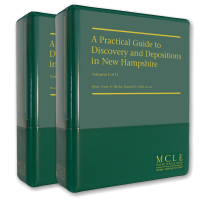
- Product Number: 2215417WFM
- Publication Date: 8/30/2021
- Edition: 1st Edition 2011, with 2018 & 2021 Supplements
- Copyright: © 2021 MCLE, Inc.
-
Add to Favorites List
Your Selection:


-
Product Description
Product Description
The forty-four chapters of this comprehensive manual are organized into five parts, addressing planning for incapacity, public benefits and employment, special issues for disabled children and adults, aging in place, and care in a skilled nursing facility. Hundreds of insights, from Massachusetts' most experienced practitioners, bring clarity to complex procedures and guide readers through the topics that are pertinent to elders and persons with disabilities—both adults and children. The book expands and updates the MCLE classic, Estate Planning for the Aging and Incapacitated Client in Massachusetts , while adding new chapters on subjects such as undue influence, special needs trusts, and ethics. A series of MassHealth chapters addresses information on protecting the family home and community spouse, transferring resources, reducing excess assets, and creating trusts. The book tackles tax and insurance issues, housing choices, the financing of services, both private and public, the intricacies of long-term care, and the myriad concerns surrounding the needs of persons with disabilities, to name just a few of the topics. Forty-seven experts wrote the book, and a cadre of nine MassNAELA members joined chief editor Brian E. Barreira to ensure currency, relevance, and highly practical value.
Recent updates:
-
Update: September 2023
Dear Subscriber,
This first edition of Elder and Disability Law in Massachusetts continues the tradition of Estate Planning for the Aging and Incapacitated Client in Massachusetts . This book updates and expands on topics covered in its predecessor publication, while adding new chapters of particular interest to estate planning for both elders and persons with disabilities. Inside, you will find coverage of thousands of practical tips and insightful analyses on case decisions, statutes, regulations, and other authoritative sources pertinent to elder and disability planning, including current material on the following subjects:
- Undue influence. Chapter 5 addresses the lawyer's duties in representing a client who is experiencing improper or undue influence that puts them at risk, whether the means be physical force, duress, threats, or other forces. Practical insights are offered on how to prevent, ameliorate, or litigate undue influence.
- Ethics issues in representing elders. See chapter 6 for caveats related to stereotyping elderly clients, navigating the family relationship, and handling joint representation. Discussion includes diminished capacity and the attorney's duties of loyalty and confidentiality, the retention and discharge of counsel, proceedings against nonclients, and aspects of the power of attorney role.
- Special needs trusts and ABLE accounts. Chapter 39 begins with a review of self-settled trusts generally, then goes on to describe the elements of self-settled and third-party special needs trusts. It discusses trust protector provisions and concludes with a discussion of VA benefits and ABLE Accounts.
- Trusts in the MassHealth context. Chapter 38 addresses the role of trusts in estate planning where an objective is to preserve eligibility for MassHealth benefits. Background is provided on OBRA '93 legislation and how Massachusetts has interpreted the law. Particulars of trusts established for disabled individuals and those established with transferred assets are discussed.
- Tax considerations regarding trusts. Among the topics covered in chapter 40 are income tax planning for Medicaid trusts and estate and gift tax planning for such trusts, taxation of testamentary trusts, taxation of trusts established by the beneficiaries of gifts, and the treatment of pretax retirement accounts.
- Property tax relief. Chapter 38 addresses real estate tax exemptions, abatements, and deferrals for older persons, their spouses, minor children, veterans, blind persons, and those experiencing hardship.
- Resource planning for MassHealth coverage. This expansive topic is addressed in detail in chapter 34 (Protecting the Community Spouse), chapter 35 (Reducing Excess Assets), chapter 36 (Transfers of Resources), and chapter 37 (Protecting the Home).
We at MCLE trust that you will find this new edition useful in your estate planning practice and valuable in keeping your law library current.
Cordially,
MCLE Press
-
Update: September 2023
-
Table of Contents
Table of Contents
expand allChapter 1 expandIntroduction
Buy Chapter Chapter 2 expand
Preservation and Spoliation of Evidence
Buy Chapter
Chapter 3 expandDiscovery Planning and Analysis
Buy Chapter
Exhibit 3A
- Order Approving Discovery Stipulation, Vention Medical Advanced Components, Inc. v. Pappas Buy FormChapter 4 expandProtecting Confidential Information in Litigation
Buy Chapter
Chapter 5 expandDiscovery of Internal Investigations
Buy Chapter
Chapter 6 expandDiscovery Plan/Structuring Conference Preparation and Practice
Buy Chapter
Chapter 7 expandInterrogatories
Buy Chapter
Exhibit 7A
- Sample Notice of Interrogatories Pursuant to New Hampshire Superior Court Rule 23 Buy FormChapter 8 expandDocument Requests
Buy Chapter
Chapter 9 expandRequests for Admission
Buy Chapter
Chapter 10 expandThe Attorney-Client Privilege and the Work Product Doctrine
Buy Chapter
Chapter 11 expandChapter 12 expandDepositions
Buy Chapter
Chapter 13 expandAnalyzing and Responding to Discovery
Buy Chapter
Chapter 14 expandE-Discovery and Internet/Social Networking Discovery
Buy Chapter
Exhibit 14A
- Sample Electronic Discovery Outline for Preparing or Deposing a Business Witness Buy FormExhibit 14B
- Sample Questionnaire for Interviewing Client Technology Personnel Buy FormExhibit 14C
- Sample Notices (Formal and Basic) Buy FormExhibit 14D
- Sample Preservation Letter Buy FormExhibit 14E
- Model Order Regarding Preservation Buy FormChapter 15 expandDiscovery Practice
Buy Chapter
Exhibit 15A
- Rule 11(c) Certification Buy FormExhibit 15B
- Verification Buy FormExhibit 15C
- Rule 3(a) Certification Buy FormExhibit 15D
- Motion to Strike Request for Admissions or, Alternatively, Motion for Protective Order Buy FormExhibit 15E
- Motion for Protective Order Buy FormExhibit 15F
- Request for Admissions Buy FormExhibit 15G
- Motion to Compel Answers to Interrogatories and Responses to Requests for Production of Documents Buy FormExhibit 15H
- Motion for Conditional Default Buy FormExhibit 15I
- Motion to Strike Conditional Default Buy FormExhibit 15J
- Motion for Entry of Default Judgment Buy FormExhibit 15K
- Taxation of Costs Buy FormExhibit 15L
- Motion for Appointment of Commissioner to Take Out-of-State Depositions Buy FormExhibit 15M
- Motion for Issuance of a Letter Rogatory to Out-of-State Court Buy FormExhibit 15N
- Motion to Quash Subpoena Buy FormExhibit 15O
- Motion for Reconsideration Buy FormChapter 16 expandObtaining Interstate Discovery
Buy Chapter
Exhibit 16A
- Sample Order of Commission Authorizing the Taking of a Foreign Deposition Buy FormChapter 17 expandDiscovery Relating to Experts
Buy Chapter
Exhibit 17A
- Expert Witness Deposition Outline—Deposing an Adverse Witness Buy FormChapter 18 expandMedical Discovery
Buy Chapter
Exhibit 18A
- Authorization to Release Medical Information and Records Buy FormChapter 19 expandAn Overview of Differences Between State Court and Federal Discovery Practice
Buy Chapter
Chapter 20 expandDiscovery in the Business and Commercial Dispute Docket of the New Hampshire Superior Court
Buy Chapter
Exhibit 20A
- Business and Commercial Dispute Docket Standing Orders Buy FormChapter 21 expandGovernment Discovery
Buy Chapter
Chapter 22 expandDiscovery in Divorce Cases
Buy Chapter
Chapter 23 expandDiscovery in Employment Cases
Buy Chapter
- Editors & Authors